Wednesday, 2 January 2013

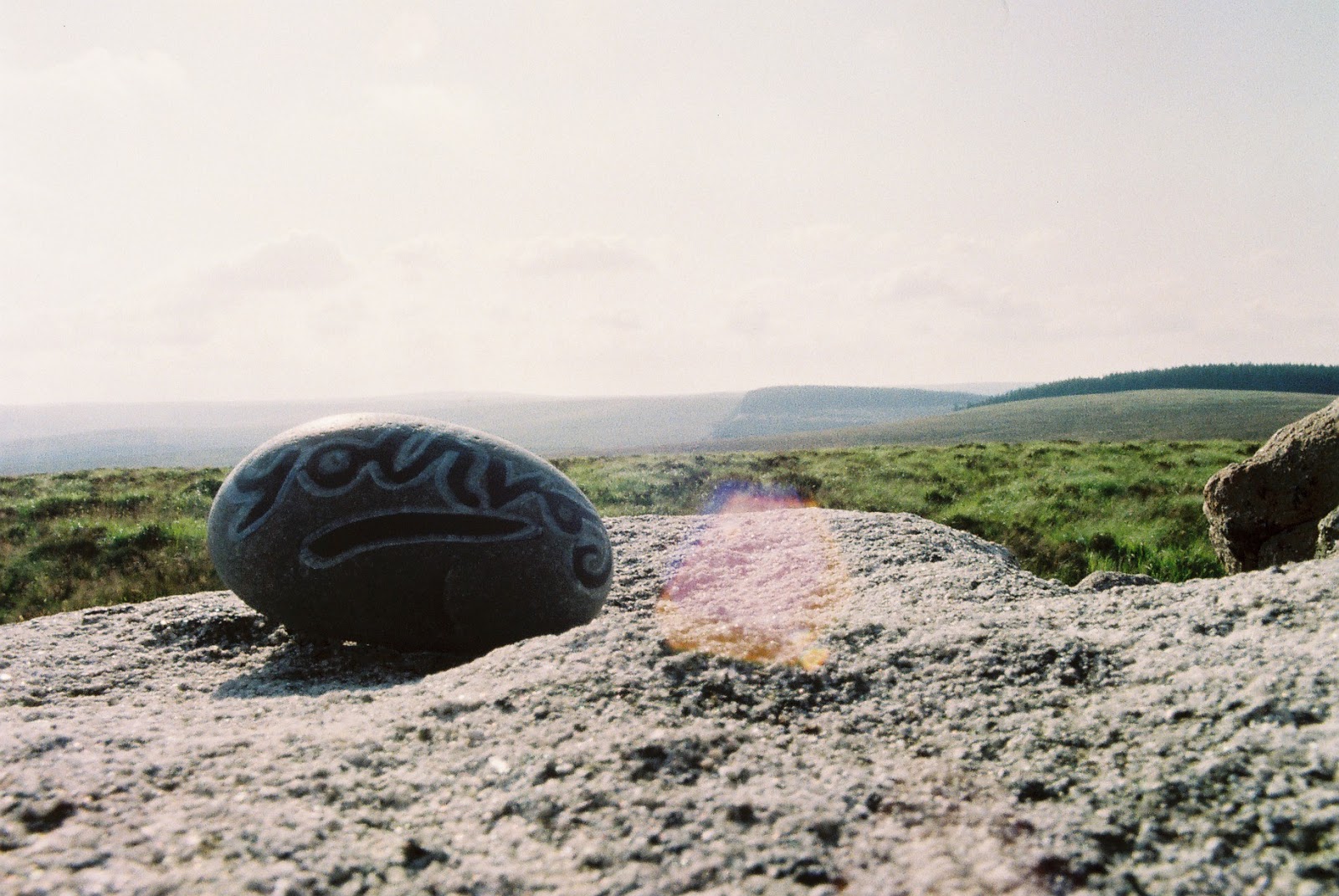
GOTHVOS PIEZOELECTRIC PRESENCE


Three exposures made with a prepared Nikon 35mm Film Camera and Vivitar Lens. In the Isles of Scilly on the Pump Road near Parting Carn Moor.
This Blog is quite messy in its current incarnation the key focus, via Negativa or  locating a Tabula Rasa in which to place the Potent Object the Gothvos Narrative if you will: these themes and images lay scattered around in various guises, the online saga is the usual torture of making hasty choices in hardware and then being hacked about by larger accommodating websites who are suddenly no longer accessible - my own fault in being attracted to the myth of the free lunch. So please scratch the surface, there is more and don't be put off when you read repetitive information, my role is changing as this becomes a Community project I find myself a more curatational role replete with the considerations of enmeshing different perspectives. The Gothvos is about a particular type of stone arising from a particular place from which Cornish Stone Axes were made, over 450 have been retrieved from all over the joint so far. They crop up in books and museums and they represent something extremely fundamental to me about Place geographically, about Language culturally and about the individual in society. I lean heavily on the broadest terms, Landscape and Consciousness.
I have spliced a theatricality into my own way of doing things. Combining this experience  (praxis) with geological and geographical datum, societal, anthropological factors and experimenting with cameras and film emulsions I'm proposing that the potent object is positioned via negativa  through the threshold of a tabula rasa. The potent object releases potential through the hand of the appointed activist, for them ( the catilyst or author) the ultimate action is now to position and document this contempletive act - the piece must fit or be found a more perfect location, only then can the object rest and maximise an emerging compositional matrix. There may be gaged tangible elements present: residual body warmth or smooth density in the stone, external weather conditions - particularly light and available trajectory plinths there will certainly be exposure to piezoelectric influences. It is interesting and rewarding to note that already some reactions have found their way back to me, people are curious about the little stones provenance and cultural inscribed word, the action must be recorded and the object given up or abandoned before the object regains potential in a revitilized composition. 


The old sunken forest of Carreck Loes or Mounts Bay, my school teacher Mr Steve Ottery, encouraged an enquiring mindset he sent us forth on inquiring about Carbon 14 testing of the pollen layers and petrified oak stumps of this sunken landscape over on the mainland (we were on Scilly) . Carbon fourteen was explained and duly acknowledged, the existence of a Green Stone now submerged, called The Gear Rock, where Axe Makers came to get Greenstone. This is one of the closest locations for the Gothvos placings, this stone, I'm fairly sure became submerged but it may have attracted someone to move it to a new Tabula Rasa.
The rock exposures around St Michael's Mount provide an opportunity to see many features of the geology of Cornwall in a single locality. The mount is made of the uppermost part of a granite intrusion into metamorphosed Devonian mudstones or pelites. The granite is itself mineralised with a well-developed sheeted greisen vein system. Due to its geology the southern coast of the island was designated a Site of Special Scientific Interest in 1995.
Gothvos of the Elevated Section of the A30 Penzance By-Pass.
(St.Michaels Mount is to the left of the moving tractor)


At the end of 1875 Edison and his assistants were experimenting with the Acoustic Telegraph when they noticed that a rapidly vibrating spark gap produced a spark in an adjacent relay. Subsequent investigation showed that the phenomenon could be made to occur at a distance of several feet without interconnecting cables. Edison, with this small amount of evidence, announced that it was "a true unknown force" since he believed that the spark transmitted electricity without carrying any charge.  Edison concluded that this discovery had the potential to cheapen telegraphic communication and to allow transatlantic cables to be laid without insulation. He was also interested in finding new forces as a means for providing scientific explanations for spiritualist, occult and other allegedly supernatural phenomena following his disenchantment with Helena Blavatsky's Theosophy.
Edison's apparatus consisted of a spark gap vibrating at a high frequency powered by batteries and connected to tin foil sheet about 12 by 8 inches, effectively acting as an antenna. A similar tin foil sheet, connected to ground was located at about eight feet away with two more similar, un-grounded tin foil sheets between. Sparks could be seen at the "receiver" sheets. The last laboratory notebook entry on etheric force in 1875 can be seen at The Edison Papers.
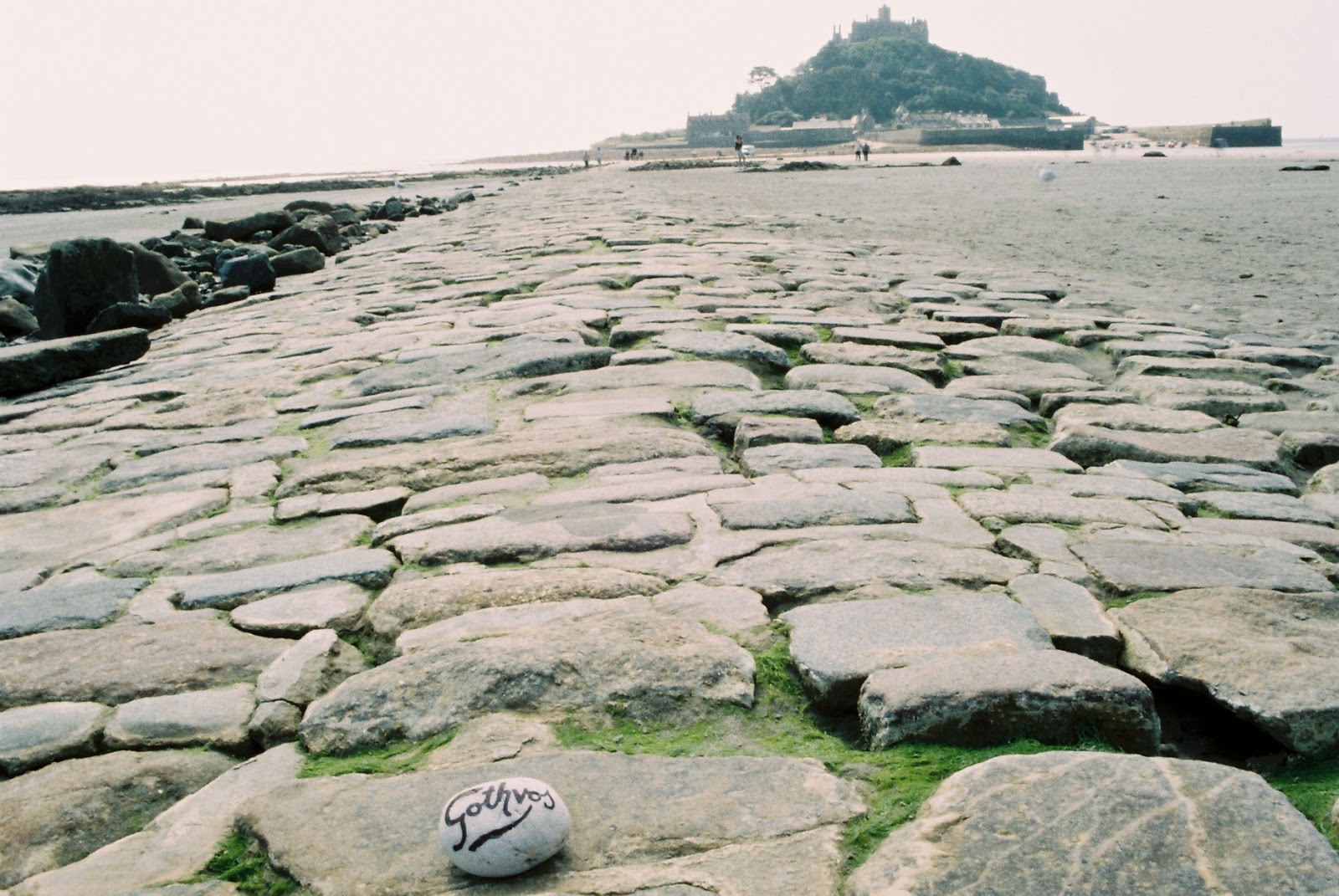
Carreck Loes St.Michaels Mount.


One of the former roles of monasteries and priories, like St.Michaels Mount in the Middle Ages was to offer aid, food, lodging and conditional spiritual guidance to pilgrims. Hundreds of thousands of them walked across the causeway from throughout Europe to the fringes of the "known" and frequented or undocumented societies. Apart from adventure, many could have sought redemption of a kind unfamiliar to the more consumer orientated society and an easier route to paradise as witnessed by the relics of saints in sacred places. During the 12th-14th centuries, pilgrimage became increasingly popular, particularly along routes linking sites devoted to St Michael and those that led to St Iago de Compostela in Spain. Many pilgrims travelled to Canterbury Cathedral in England (see Geoffrey Chaucer's The Canterbury Tales) where archbishop Thomas Beckett was the saintly attraction, his murder in 1170 having been incited by his former friend, King Henry ll, Duke of Normandy. But the connection between St.Mont Michelle and St.Micheals Mount became difficult during the 100 Years' War and both islands were fortified. There are other islands similar to St. Michaels Mount more easily identified as Breton, Mont San Michelle has been disputed territory between Brittany and Normandy owing in part to the Norman invasion of Britain and the gifting of Earldoms for favours, the reason seems to be upheld that it is the tidal flow that bestowed the property to Normandy. A small Islet close to Mont San Michelle is the reputed burial site for King Hoël of Wales.

OGHAM


According to Professor Greene, written or inscribed Ogham, was an archaic speech of the Druidic fraternity, which he considers unintelligible to non druidic readers, he suggests that it was written in an archaic language, rather similar to modern english use of latin. 

"When we find Irish written in Roman letters, from the seventh century onwards, a linguistic revolution had taken place, with words greatly reduced from their Ogham forms. This is a paralell to the changes which took place in France and the other Roman languagesas compared to latin, and it is possible that the historic process was the same. Of the six Ogham inscriptions in Cornwall, all carry an inscription in latin repeating the name of the commemorated person. There are also numerous Latin inscriptions, some bear the Chi Rho, one of the earliest Christian symbols derived from the first two letters of thge Greek word for Christ. A Cornwall where undocumented Kings ruled of whom we can only derive the scantiest information. 


Porth Kidney Gothvos (T'wards Trencrom)

Ogham 


The earliest inscriptions in ogham date to about the 4th century AD, James Carney believes its invention is within the 1st century BC. Although the use of "classical" ogham in stone inscriptions seems to have flowered in the 5th–6th centuries around the Irish Sea, from the phonological evidence it is clear that the alphabet predates the 5th century. A period of writing on wood or other perishable material prior to the preserved monumental inscriptions needs to be assumed, sufficient for the loss of the phonemes represented by úath ("H") and straif ("Z"), as well as the velar nasal, gétal, all of which are clearly part of the system, but unattested in inscriptions.
It appears that the ogham alphabet was modelled on another script, and some even consider it a mere cipher of its template script (Düwel 1968: points out similarity with ciphers of Germanic runes). The largest number of scholars favours the Latin alphabet as this template, although the Elder Futhark and even the Greek alphabet have their supporters. Runic origin would elegantly explain the presence of "H" and "Z" letters unused in Irish, as well as the presence of vocalic and consonantal variants "U" vs. "W" unknown to Latin or Greek writing. The Latin alphabet is the primary contender mainly because its influence at the required period (4th century) is most easily established, viz., via Britannia, while the runes in the 4th century were not very widespread even in continental Europe.
In Ireland and in Wales, the language of the monumental stone inscriptions is termed Primitive Irish. The transition to Old Irish, the language of the earliest sources in the Latin alphabet, takes place in about the 6th century. Since ogham inscriptions consist almost exclusively of personal names and marks possibly indicating land ownership, linguistic information that may be glimpsed from the Primitive Irish period is mostly restricted to phonological developments.

Mên Scryfa, inscribed stone, Morvah. Cornwall
Craig Weatherhills excellent book Cornovia describes The Mên Scryfa: The stone stands in a field on the north side of the track, 300m beyond the Mên-an-tol (site 29 in his book) The northern face of this stone, which stands 1.8 tall, is clearly inscribed to the memory of RIALOBRAN - CVNOVAL-FIL-(Rialobran, son of Cunoval). These names in modern Cornish Ryalvran and Kenwal, mean respectively 'Royal Raven' and 'Famous Chieftain', so the stone almost certainly commemorates local royalty of the sixth century AD, the date ascribed to the style of lettering used.
Writing emerged in a variety of different cultures in the Bronze age. Examples include the cuneiform writing of the Sumerians, Egyptian hieroglyphs, Cretan hieroglyphs, Chinese logographs, and the Olmec script of Mesoamerica. The Chinese script likely developed independently of the Middle Eastern scripts, around 1600 BC. The pre-Columbian Mesoamerican writing systems (including among others Olmec and Maya scripts) are also generally believed to have had independent origins. It is thought that the first true alphabetic writing was developed around 2000 BC for Semitic workers in the Sinai by giving mostly Egyptian hieratic glyphs Semitic values(see History of the alphabet Proto-Sinaitic alphabet). The Ge'ez writing system of Ethiopia is considered Semitic. It is likely to be of semi-independent origin, having roots in the Meroitic Sudanese ideogram system. Most other alphabets in the world today either descended from this one innovation, many via the Phoenician alphabet, or were directly inspired by its design. In the case of Italy, about 500 years passed from the early Old Italic alphabet to Plautus (750 to 250 BC), and in the case of the Germanic peoples, the corresponding time span is again similar, from the first Elder Futhark inscriptions to early texts like the Abrogans (ca. 200 to 750 CE
There are currently estimated to be approximately 6000 languages existing within the various contemporary societies.

Gothvos Godhvos


Needles of Time Author Tom
TEMPEL
Temple Church is a place I've visited fairly often, the associations with the Knights Templars and the Hospitaliers as well as Temple Churches former reputation as a "Gretna Green" type of facility offering ex officio marriage ceremonies and burial rites to victims of suicide or the unbaptized dead helps to support a notion that the location is a place for solace and contemplation, this is reinforced by Temple Villages moorland otherness, the hamlet is more or less a farm. I've put a link to the Needles of Time authors book published in the late seventies I've done this because in broad terms I agree with some of the geomancy ideas of which I'm sure there will be further questions from me. In the present context I'm interested in Temple as a wayside facility on a former track used most notably to move Tin from Damnonian mines on Dartmoor to the safety and eventual dispatch by sea from Damnonian sea ports on each coast of Modern Kernow.

KOWSIC GOTHVOS

Above Two Bridges near the Warren Inn situated around 2.5 km (1.6 mi) north east of Princetown on the old turnpike road which was built across Dartmoor in the late 18th century (now known as the B3212).
A map dated 1765 suggests the origin of the name, for in those days the road crossed both the West Dart and the River Cowsic, just upstream from the point where they meet, and required two separate bridges possibly a remnant of national border fluctuations as saxon Devon pushed further west into Kernow.
By 1891, these had disappeared and there was just a single bridge, further downstream, over the West Dart. Today, however, there are again two bridges on the site, because a more modern structure has been added alongside its earlier predecessor, to carry moor traffic.In the 18th century, Two Bridges was commonly known for its potato market. The site was no doubt chosen because it is in a central location, and easily accessible on what was then, and still is now, a serviceable road across Dartmoor. Some small quarries in the vicinity show that there was also quarrying industry in the area.


BLUE CARN GOTHVOS ST.MARY'S ISLES OF SCILLY.


TRYTHAL GOTHVOS

A Grankan, a grankan,
a mean ow gowaz o vean
ondez Parc an Venton
pub trelowza vean
Far Penzans a Maragow
Githack Mackrow
a mac trelowza varrack.
A poem recorded by listening to John Davey b.1812 St.Just. d.1891 Boswednack written down by J.Hobson Matthews and published in his History of St.Ives 1892.
Despite the insistence by some that first language or native Cornish Language died with Dolly Pentreath or William Bodener these events occurred a century earlier than John Davey's oration of his own poetry.
O Crankan! O Crankan!
On the rock thou hast but little
Further than the Well Field
That will grow three sprouts to each stone
The Penzance and Market Jew road
Is vastly more green and vastly more fresh
And will nourish three sprouts to each rider.
*

An evening on St.Agnes Beacon towards St.Ives.
An Gwlascarer - A.S.D. Smith
Ny allaf-vy kewsel Kernewek
Ny allaf y scryfa ha whath
Re gales yu tavas mar uthek
Predery anodho a-m-lath!
The Patriot by A S D Smith
I cannot speak Cornish
I cannot write it either
Such a terrible language is too hard
It kills me to think about it.

Looking towards St.Agnes from Carn Marth


Ludgvan Gothvos a longer interlude.


STONE AXE STUDIES, VOLUME III Edited by Vin Davis and Mark Edmonds
Oxbow Books,  2011, 444pp, many colour and black and white illustrations, tables, ISBN 978-1-84217-421-0, hb, £48

Stone Axe Studies Volume III (SAS III) has largely sprung from a symposium held in York in 2007 and is a welcome addition to a somewhat erratic series (no glacial pun intended; cf Clough & Cummins 1979; Clough & Cummins 1988), produced firstly under the auspices of the Implement Petrology Committee, but latterly by the Implement Petrology Group under the steer of the indefatigable Vin Davis who should be congratulated on such a beautifully produced and useful book.

The book is divided into thirteen sections each of two or three chapters, and curiously to this reviewer, most begin with an un-attributed word sketch or cameo that appears to be quite random in nature and a tad pretentious.  However, the quality of the papers and the presentation of the book more than makes up for this slight aberration.

The introduction by Vin Davis and Mark Edmonds sets the scene for the 27 chapters which present research focussed particularly upon stone axe blades (an approach which complements the original web-based symposium proceedings which have a wider remit).  SAS III focuses upon Europe primarily, but with brief forays into India, Australia, the Middle East and New Guinea, thus providing useful comparative material.  The scale of the research ranges from single artefact types such as the Nøstvet axe with its relatively restricted distribution in Scandinavia, to the big hitters such as the Alpine axeheads and their extensive Europe-wide dispersal.  There are also wide-ranging reviews from axe hafting systems recorded at certain lakeside settlements in the French Jura, to the issue of axe size in Orkney, as well as   an update on the Irish Stone Axe Project. 

The introduction rightly (in this reviewer’s opinion) outlines the overarching focus for the majority of the papers and this is  to take  stone axe research beyond typologies and lithologies and into the realm of contextualisation: what were the biographies of these tools and what did they mean to the communities who made and used them?  The identification of sources is clearly an important element in understanding the distribution patterns and trade/exchange networks – which in the case of the UK and Ireland was extensively explored in the first two SAS volumes.  The current volume seeks to take research beyond sourcing and typologies and explore the social context of these tools.  The book is packed with useful research so only a selection can be discussed in any detail in this review.

In western Norway, Bergsvik and Østmo discuss the presence of TRB axes which originated in southern Scandinavia and appear to have been distributed along the coast via the Oslo fjord.  The axes recovered from secure contexts were deposited in graves and settlement sites and were found in both unused and worn conditions.  This situation is paralleled with contemporary adzes.  It would seem that Neolithic acculturation struggled to gain influence in this region before the appearance of the TRB culture when these axes were introduced as special artefacts into the hunter/fisher lifeway, and became instrumental in refocusing communities inland and into the forested areas, as part of the technological package which introduced small-scale agriculture to the region.  However, importantly, most TRB axes had not been used and few were deposited at settlements; most seem to have been found buried at elevated locations.  Clearly here we can see the influence of the introduction of a new form of axe – alongside a suite of novel life-style concepts – which has led to profound social change in this part of Scandinavia.  Interestingly, during the preceding Late Mesolithic period, Nøstvet axeheads may have been associated with canoe construction in the environs of the Oslo fjord; therefore the infrastructure was probably in place to facilitate the distribution of the TRB axes along the coastline and river networks – one axe type creating the foundations for the distribution of another later type.

Pétrequin and co-authors provide another aspect of their continuing research on jadeitite sources  with an analysis of colour choices facing the users of Alpine axes.  Although the generalities of the story behind the eclogite and jadeitite axes will be familiar to many through the preliminary publications of the innovative and influential Programme Jade, this paper explores the largely separate distributions of the axes crafted from these differently coloured rocks.  The background to the 5th- 4th millennium BC exploitation of these rare raw materials in the Mont Viso and Mont Beigua massif has been rehearsed elsewhere, and the fact that these axes were circulated up to 1056 miles (1700 km) from their source.  However, the nuanced facts behind the familiar story make interesting reading.  The first utilitarian Alpine axeheads were largely non-jadeitite types, which were circulated to the north and west; jadeitite and omphacitite were reserved for small tranchet axes and stone rings.  By the mid-5th millennium BC jadeitite had become the dominant raw material and was used for 95% of all Alpine axes found between the Alps and the Gulf of Morbihan – although curiously northern Italy appears to have been excluded from this distribution.  The north-westerly circulation eventually progressed onto the Atlantic fringes of Europe.  This project has also discovered a duality in use/deposition patterns whereby certain jadeitite axes were purely functional but others were reserved for ritualised deposition at special places in the landscape or in tombs, especially in the Carnac region where axes prominently figure in local rock art.  It is interesting to speculate upon the role of the communities inhabiting the Gulf of Morbihan and their part in initiating, or certainly sponsoring, the increasing desire to possess exotic Alpine axes to the extent that local imitations in flint and other stones proliferated.

The Carnac region also produced evidence for a phase of secondary re-working of Alpine axes, which were found to have been re-polished in the Morbihan and then put back into the distribution network where they were transported in all directions, even back to the Alps, Italy and Croatia.  This secondary re-distribution may then have stimulated the shaping and  style of the large decorated stelae.  However, the secondary re-distribution of axes is comparatively light in these regions and almost non-existent in the Iberian peninsula.  As the authors suggest, the distribution pattern of the various types of axe, and their density, must reflect differing social contexts across Europe, but that some level of commonality existed surrounding the special nature of the Alpine axes which clearly underpinned important ritualised belief systems and social narratives.  Alongside the typo-chronological model presented by the authors, there is much here to ponder and stimulate new debate on the contexts of procurement, production, and the varied exchange, distribution and final deposition of these axeheads.  Overall, Programme Jade sets a new benchmark for the study of axes, and it is to be hoped that others might follow this lead.

Brumm discusses the symbolism which underpins the production and exchange of edge-ground axes in southeastern Australia – an axe type which has been used in this area for some 5000 years for woodworking and procuring wild resources such as honey and possums.  The raw material for these axes originated from both secondary sources and outcrops, and axes crafted from the latter sources were distributed more than 620 miles [1000km] from the outcrops, demonstrating the social value embedded in certain tools.   The mechanisms for such artefact movements are exemplified by the Mount William greenstone quarries where long-distance gift exchange was undertaken between interrelated groups – thus providing material evidence of social relations, kinship links and alliances.  At Mount William the local clans provided a hereditary custodian who lived at the quarries and controlled access and exchange via strict protocols; the custodians were also given safe passage through all clan lands – an interesting model perhaps for the movement of Alpine jadeitite axes? (but without year-round dwelling at the high altitude quarries!).  These Aboriginal custodians were responsible for maintaining the linkages between the creationary beliefs of the Dreaming and the stone sources.  In particular, many of these beliefs describe the importance of axe-wielding Ancestral Beings and their role both in sculpting the topography of the landscape and the perception within some communities that axes were integral to the maintenance of mythical props which held up the sky.

Such social contextualisation is often ignored in European prehistory as most hypotheses relating to extraction sites and their products focus upon economic drivers or technical analyses and not what axes might ‘mean’,.  How many authors still refer to ‘factories’, for instance, or other such loaded terminology?  The fact that ethnographic records describe the creation and use of many stone tools or other artefacts produced from exotic sources specifically to underpin social rather than economic networks, is a rallying call for more holistic analysis – as suggested by the editors in the introduction.

Ballin describes recent fieldwork at the surprisingly extensive felsite quarries of North Roe on Shetland.  Often overlooked previously, these quarries are now recognised as one of the UK’s largest extraction sites.  The felsite outcrops are located in the northwestern part of the archipelago and are at their most intensive at the Beorgs of Uyea.  This raw material was primarily exploited for the production of axeheads and the eponymous Shetland knives during the Early/Late Neolithic transition.  Interestingly, and like so many other quarries, only roughouts were produced on site in workshop areas.  A number of putative Neolithic houses and shelters intermingle with the quarries.  It is clear from this project that different types of felsite were chosen for specific artefacts (similarities here with jadeitite?), and this deliberate selection implies that varying cultural values were being placed on each source.  Curiously, despite this level of sophistication, it would appear that no felsite artefacts were transported off the islands, and conversely very few non-local examples entered the archipelago exchange network.  Such apparent material culture ‘protectionism’ clearly implies strict conventions or taboos in place which relate to the exploitation of raw materials and the production and exchange of implements on or into the Shetland Isles.  This study provides a neat counter-point to the well-rehearsed story of the equally extensive Langdale axe quarries and their widely distributed axeheads in north-west mainland Britain.  

In the Seine Valley, Giligny and co-researchers have studied the trade and exchange of axeheads in the region and have discovered that the earliest stages of manufacture occurred at workshop sites or at settlements close to the mines.  The roughouts were then transported up to 30+km from the sources.  In this region distribution patterns were influenced by the availability of raw material – tertiary flint is more prevalent south of the Seine a marked contrast with the north where secondary deposits dominate alongside a greater proportion of imported exotics such as Armorican dolerites.  Part of this distribution pattern is explained by the fewer flint mines to the north of the river, which presumably stimulated the reliance on secondary deposits.  Similar values may have been embedded in the imported Group B Armorican axes originating from Le Pinacle (Jersey) and Plussulien (Brittany) which form the largest components in the assemblages south of the Seine and those to the northwest framed by the Seine and Epte, and still comprise the second largest element in the northeastern assemblages.  Consequently, the Seine and its tributaries may have acted as a form of psychological barrier to the northerly movement of axes from flint mines located in the south.  Conversely, however, the river network was clearly being used to facilitate the long-distance movement of special types of axes such as the aforementioned Armorican examples, and those from the Italian Alps.  Interestingly, Seine Valley axes are also found in Armorica, implying some form of reciprocal exchange.  Clearly this project is throwing light on a complex distribution pattern which contrasts the movement of local with non-local axeheads.  Hopefully the next stages of this project will further elucidate the chronology of the flint mines and explore their relationships with the workshops and the settlements to add more detail to this interesting example of the social context of axe production and distribution in this part of France.

Davis and Edmonds provide a review of recent work on the Langdale Group VI axes from Cumbria and confirm that the quarries were exploited primarily for roughouts, but that there was some variability in production between individual quarries which might reflect social or technical constraints.  In southern Scandinavia Larsson describes the special uses of axes from their crafting (often at enclosures) to structured deposition in megalithic tombs, deposition in bogs or transformation by fire as a prelude to deposition.  At Mynydd Rhiw in North Wales, Burrow has demonstrated that the extraction of the tufaceous sediments occurred over a much larger area than previously recognised, some 7.75ha, but curiously there is little evidence currently for much product having been exported off-site.  At the opposite extreme of the Welsh spectrum, Williams and colleagues discuss the widely distributed Group VII axes from Graig Lwyd and the use/deposition patterns that have recently emerged at the nearby excavations at Parc Bryn Cegin, Llandygai, Gwynedd, and how this data is being used to enhance our understanding of the chronology of the quarry site.  This chronology suggests that Graig Lwyd was exploited for much of the Neolithic period and that its products were subjected to deliberate reduction or fragmentation sequences at certain points in time, particularly immediately before deposition, and that many of these deliberately modified or broken axes were then placed in pits as a final stage in their individual biographies.

Maigrot describes the analysis of Middle/Late Neolithic axe hafting systems discovered at the lakeside settlements in the French Jura.  Of interest here is the use of intermediate antler sleeves to hold the smaller axeheads securely in their wooden hafts.  Interestingly, these settlements had developed and increased in number at a climatic upturn, which coincidentally appears to have impacted upon deer populations thus reducing both the numbers of animals and the quality of the harvested antler.  Consequently, sleeve manufacture had to adapt and increased recycling of used antler sleeves over time is marked.

On Orkney, Clarke has studied axes both from recently excavated assemblages and newly accessible stray finds.  This has led to the recognition that the sizes of axe blades could be determined by use, and that those recovered at chambered tombs or from ‘special deposits’, were distinctly larger than those found on settlement sites.  In both general contexts the axes were often found on floors, which in the case of the tombs may have been a ritualised act, whereas at the settlements such locations may simply reflect accessible storage.  Curiously, the source of indigenous Orcadian axes remains unknown – perhaps an interesting future post-graduate project ?

Field presents a timely review of axe distribution from central southern England and has discovered through careful analysis (surprisingly no such research has yet taken place in Wessex) that the mouth of the River Avon is a key location to understanding the movement of axes in Wessex.  He also wisely points out that our knowledge of the development and obscuring of the early Wessex landscape may have led to river valleys being overlooked as important locations for early Neolithic activity.  Yet another interesting project idea ?

Pétrequin and Pétrequin provide a salutary lesson from New Guinea and present a series of interpretative models of axe production, use and what axeheads ‘mean’ to people based upon their 21 years of fieldwork.  The authors emphasise the dynamics of the social role of axes, and how they are perceived by their contemporary users as a material metonym which recreates and symbolises themselves.  They have found that technical products cannot always be divorced from ritual acts which create socially valorised tools that embody cultural imagery.  In New Guinea the axeheads are perceived as already existing within the bedrock of the ‘Axe Mountains’ – the manufacturers and ritual specialists simply free them from these sedimented bodies of the Primordial Beings, much like the ethnography of Aboriginal Australia (see above).  In New Guinea an extreme example of ritualised behaviour occurs at the Awigobi quarries where some polished axeheads are dressed in a miniature skirt with pendants which have been crafted from the fur of the tree kangaroo to transform the axe into a ‘woman of stone’.  Such unusual records are reminiscent of the tchamajillas of the Native American Puebloan communities which are symbolically fed milk and rocked like a baby (cf. Topping 2005, 89), and remind archaeologists of the interpretative difficulties in analysing the true contexts of apparently mundane, functional tools.  This paper provides much food for thought.

Overall, this is a useful and important book which should be read by everyone interested in early material culture and the production and use of axes and what they might have meant to their contemporary communities.


References

Clough, THMcK & Cummins, WA (eds) 1979.  Stone Axe Studies.  London: Council for British Archaeology Research Report 23.

Clough, THMcK & Cummins, WA (eds) 1988.  Stone Axe Studies: Volume 2.  London: Council for British Archaeology Research Report 67.

Topping, P 2005.  Shaft 27 Revisited: an Ethnography of Neolithic Flint Extraction.  In Topping, P and Lynott, M (eds) The Cultural Landscape of Prehistoric Mines.  Oxford: Oxbow Books.  63-93.

Pete Topping
English Heritage
January 2012


The views expressed in this review are not necessarily those of the Society or the Reviews Editor


Thursday, 13 September 2012

Beyond the Sea, Beyond Brocade, Beyond Beyond.

http://www.arthousecoop.com/submissions/20643

HIERARCHAEOLOGY.

The word textile is from Latin texere which means "to weave", "to braid" or "to construct". It is important for me to reconsider the fact that Strands or Yarns were the predecessor of sheet's or bolts of fabricated textile. A good example of sheet textile art is felting, in which animal fibers are matted together using heat and moisture, but wether Felting preceded yarns is unlikely to be either defined or established here, in my order of things the strand came first, and binding must have been the earliest form of conjoining two separate elements with a third. Our forefathers were not averse to the use of leather strands: thongs, which require more basic processing than the vegetable originating fibres.  Textile Art occupies a very undervalued position in the fine art equation, requiring a Name to add value rather than the intrinsic value of its artful spin off, something in the order of a Warhol multiple or a Hirst Spot Rug. Although this value system is chronically flawed, I think it works in my favour regarding the range of idea's I'm most interested in.
Conceptualizing one of the social phenomena that I keep returning to, the process and action of Work/Shared industrial cooperative activity, certainly we see it modulating in the real world and more rapidly fluctuating now than in previous centuries, the idea of "Doing Together", organized or spontaniously making things in a distinct group of contributing individuals, there are many ideas as to why this general action is changing, the usual stereotypical propositions are plainly obvious chief among which the rise of the individual, particularly in Art.
Textile Art is made lesser simply by the substitution of the second word by the first. Primarily there is Art (fine art) and then there is Textile Art (craft work).The consensus being that Art is for mens dreams and Craft is for women's work.Art is refined as closely to an idea as possible, craft is simply getting the right material and forming it.....a bit.
Mengwytha Pendeen
 Stereotypically artists as we know/knew them are commonly male individuals. Art as we knew/know it is a physical manifestation of paint (oil) and canvas, that is the pinnacle in material terms. Artists were established in the Renaissence through sponsorship, often through religion or monarchy, they were paid for their extraordinary powerful figurations: visions which developed sleight of eye through Composition, Scale, Proportion and Perspective, standards of measuring physical logic. The Subversive Stitch They became superlative craftsmen but they called themselves Artists and their techniques or their craft was far outweighed by the phenomena of their artful visionary manifestations. 
 Crafts arise from  desirable proximities, amplified senses, climatic variations, geomorphic consequences, stuff found hanging around by people wanting to transcend their existence: presaging Art. These new superlative craftsmen: Artists considered themselves apart because everyday they were contemplating Life, The Universe and Death and everything, the more financially secure ones had assistants to do the craft leaving them to do the conceptualizing and any signature "dishes" in their repertoire. The Masses were all crafts people, they made stuff together, this is not to evoke some hovis platitudes I'm simply comparing the activity undertaken by an autonomous or autocratic group of persons all present in the same vicinity without the tyranny of a plethora of emails, relentless phone communication ordering stuff online, delivered by angry white van man out of cyber lorry park wilderness and into your collective life-style montage.

Like art, craft can have lowly beginnings in food chains and floral, faunal husbandry it is a direct consequence of the aspirations of the inhabitants of a particular habitat, craft is deployed in order to turn trees into baskets, rocks into car components. It was never intended to develop beyond the sacred psychotic visions of the lofty overlords, the hermits, the anchorites and kings but the part played by ornament and textiles to help establish rank, order and hierarchy was too seductive.
 Sometimes you just know you have to walk on real grass, I recently looked around St.Ives attempting to locate the site of the Fishing Net Looms from the old industry that my great, great grandfather (on my fathers side) would have known, the nets used to be made there but not because the net fibre materials were grown nearby,  Other factors came into play, the primary reason was the close proximity to the sea and the abundance of fish, with the mining industry attracting the railway being extended further southwest. Earlier this preceding century fishing nets were no longer locally manufactured in St.Ives, in fact local industrial textiles practically everywhere were priced out by the beginnings of globalism, they came from Spain and currently they for the most part come from China.
My grandmothers father was a naval officer on board H.M.S. Isis during the Boxer Rebellion, when foreigners to China were openly distrusted for their acquisitive actions and tendencies. The Society of Righteous and Harmonious Fists, known by foreigners as the Boxers, or "Yihe Magic Boxing", was a secret society founded in the northern coastal province of Shandong consisting largely of people who had lost their livelihoods due to imperialism and natural disasters. The group originate from the Lí sect of the Ba gua religion group. Foreigners came to call the well-trained, athletic young men "Boxers" due to the martial arts and calisthenics they practiced. The Boxers' primary feature was spirit possession, which involved "the whirling of swords, violent prostrations, and chanting incantations to Taoist and Buddhist spirits. I was really touched that my grandmother left me two lacquer trays that her father had acquired in his time in China, she had noticed my adolescent interest in them. My grandmothers father left the royal navy and became the Revenue Man on the Isles of Scilly, (coastguard) not a desperately popular job among the Scillonian inhabitants although my grandmother was considered quite a catch for her Scillonian husband: my grandfather. Both of my Great grandfathers were separately active participants in attending the rescue of an Italian ship called the Isabo which wrecked one early evening on October 28th 1927. My grandmothers father received a signed (by Benito Mussolini) vellum and bronze medal now hanging in the Isles of Scilly Museum for his part, my grandfathers father was a hard hat diver as well as a fisherman who brought up the perished souls in their seized expressions of agony or begging forgiveness. As far as I know he was not recognised and his diving gear that was kept in a small banked shed that has recently become the Porthcressa Regenerated Tourist Centre wasted away in the dark.  This is a true story, there are few resonant links and there are scant archetypes the story is a text-isle.


With twisting or spinning and plying fibers to make yarn (called thread when it is very fine and rope when it is very heavy). The yarn is then knotted, looped, braided, or woven to make flexible fabric or cloth, and cloth can be used to make clothing and soft furnishings. All of these items – felt, yarn, fabric, and finished objects – are collectively referred to as textiles. Yarns are stories too, embroideries and strands of narrative that link and crossover, weave and bind, suture and marlin caulk are such an obvious connection with our common history of sea travel, domestic life, mythology and language.
The textile arts also include those techniques which are used to embellish or decorate textiles – dyeing and printing to add color and pattern; embroidery and other types of needlework; tablet weaving; and lace-making. Construction methods such as sewing, knitting,crochet, and tailoring, as well as the tools employed (looms and sewing needles), techniques employed (quilting and pleating) and the objects made (carpets, hooked rugs, and coverlets) all fall under the category of textile arts.
http://www.thebeetroottree.com/exhibitions.php

The exemplary fine artist, the maker of masterpieces even in his current guise can be traced back to cosmopolitan Florence, Venice or Rome - such a legacy informs the spawning ground of the salons, colleges or "schools" wether they embrace, subvert or react to the history of art as defined by the collectors, their vision of approved art is compiled by the success or failure of the markets upon which they depend.

Odysseus Adventures: The image of the Mounts Bay Lugger Mystery which sailed all the way from Newlyn Cornwall to Melbourne Australia 1854. stitched through a hard back of Odysseus with whipping twine crafting two stories together using physical actions and affordances to create a perspective by Jonathan Polkest.


As a model of a fiscal pyramid Fine Art is the pinnacle and totally dependent upon the second layer, the commodities, manufacturing, processing, refining and making.  Arrogantly sitting above the very source of its funding, every so often a craft will materialize in the artist category, an artist in clay, an artist in wood, an artist in paper. Sculpture is the eternal truant since it is made by artists using excessive amounts of crafting. Anyway, this is all pretty boring were it not for the fact that I need to address the cultural oddities of a place like St.Ives which has had a long heritage of industrialised crafts which transgressed from stone cutting, medievil theatre, shipbuilding, farming, fishing, manufacturing fishing gear etc etc into Artists Colony.
All those crafts were undertaken by men and women who avoided the mantle of Artist building the most artful ships, the envy of all including their Breton cousins who called the Cornish Lugger "The swallow of the seas".  At an earlier point the community staged Cornish Miracle Plays - written and performed, ship building on the beaches. The simple act of pushing Marlin (tarred cotton twine) between carvel planks with a wood chisel is a contributory act towards waterproofing a wooden structure, a sculptural attribute. Tying ropes, sewing sails, rigging tackle and fishing gear by picking up these techniques and materials of the crafters legacy and allowing the unfinished, "artless' material to express influences, communicate the exposure endured in its creation.


The Invention of Needles.

Beyond Brocade

Melioramentum Gothvos