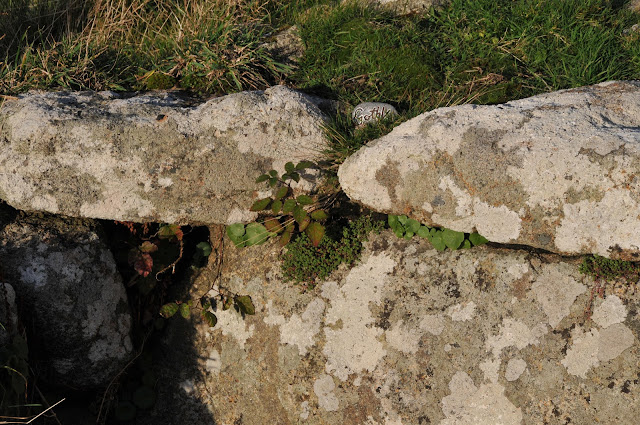
Perhaps after I have posted Johnny McGoverns elusive and at the same time, fine photographic study of a mysterious West Penwith Well, perhaps when Johnny sees his image of the well, no longer trapped inside his camera, nor floating in the digital ether of his computer, perhaps then he will know if there is actually anything further to say besides, "In this Well did he place a Gothvos stone".
A Documented account of intervention - Land Consciousness - the Potent Object: Gothvos. Landscape Art forms as significantly unobtrusive Sculptural objects placed in landscape as a means of amelioration and paralingual negotiation . Site-specific action with interlocutory consequences.
Thursday, 14 April 2022
Momentous Intent with Johnny McGovern δράω
Saturday, 16 October 2021
Julie encounters Ruskins world
23rd of September 2021, Yorkshire Dales and Lake District in September 2021 for the first time, a much needed escape following a year of Lockdown in London. Carrying my Gothvos Greenstone in my backpack over miles of hikes, passing scars, fells, forces and forests. Until the morning of my birthday, when I arrived by boat across Coniston Water to Brentwood the home of John Ruskin ; A Prophet of the 19th Century to many.
A Londoner, Ruskin moved to Brentwood on 12th September 1872. Brant originates from the Norse for "steep". The house is set in over 250 acres of woodland overlooking the visually stunning Coniston Water, including more than half a mile of lake shore laying in the shadow of the Old Man. Coincidently, Ruskin Park is close to my London home, named because Ruskin lived nearby.
During Lockdown it had been one of the green spaces I had taken a daily walk to maintain some equilibrium in all the pandemic madness.
![]() |
| Placing my Gothvos Stone at the foot of this Oak Tree gave me such a sense of peace and stillness looking out over the hills and lake below in the September sunshine, on my birthday. |
Monday, 3 August 2020
Val Thorens, Parc National de la Vanoise France.: Enter The Void.

![]() |
| Cinque Terre - Genoa 2020 |
Then along came Benjamin, a Scenographer telling his story by design, through drawing and a complex infusion of the digital signal and the constructors hammer, conducting us through a symphonic composition of herbs, olive oil, rustic infusions and Franco Battiato Niente è come sembre from his home in Firenze to the French Alps through the placing of the Object high up in the mountains on the ski slopes of Val Thorens. Adventures!
Copper - Venus.
There is evidence of medieval copper extraction in the Orco and Soana valleys. Copper was extracted from the mines present in the area, melted and processed first at the forge, and then refined, tinned and sold as metallurgical stock for the craftsmen in the workshops. The copper works have left their mark on the landscape, with the mines and the paths that lead to them, the water supplies, the forges, the workshops and the itinerant locksmiths and tinsmiths.
This tradition is now being preserved with a project by the Ecological Museum of the Orco and Soana valleys, which includes the recently restructured and refurnished copper forge at Ronco. Perhaps more importantly , is the Copper School in Alpette, where the experience of hand-crafting copper objects is passed on.
Iron or mines? at Cogne
In Valle di Cogne the presence of lode veins of iron-ore played an important part on life in the local community. Initially the exploiting of the mine was open, anybody could extract the mineral, build a forge and cut down trees to burn. At the beginning of the 19th century the metallurgical processes were modernized within the organization of the mine, with the forming a co-operative, which was superseded by "Società Nazionale Cogne", thereby reaching a high level of productivity until, like everywhere else we await news of a revival.
Thursday, 29 August 2019
A Greenstone Primer
Since google is running (ruining) my life with absurd demands for greater and greater security measures, some of those stories seem to have slipped beneath some sort of imposed horizon, a non event horizon, which leaves me feeling almost as fraught as if they had survived and were being held aloft as examples of illiteracy.
| Guirv Enes and Guerg Enes, respectively. The old Breton word Guergis not related to gavr, but to parallels such as Gaul gwery, or Old Irish ferg, signifying "wrath". |
Currently we may value Jadeite for its intrinsic value, measured in monetary terms infact we're almost obliged to refer to it in that way directly from our DNA: money and capital have existed for a long time now, who is to say there were no localised or quasi- currencies in existence five thousand years ago? I want to entertain the notion that if any currency did exist, it would be a very different undertaking than our present tokenised money, such is impregnated into small plastic cards and pixelated screens and our coinage or paper money, I do realise that the process of polishing Greenstone for many hundreds of hours, presumably to imbue it with a(n unknown) value possesses similar visual outcomes /attributes to impregnated magnetic-strip-plastic. The hazy idea of quid pro quo or bartering is a separate ordeal centred on the market place and trading, although that could form an eventual over generalised concept of what drove these people, I'm looking for values be they moral and or aesthetic. Instinctively (for that is the territory) I'm drawn to a limited shared value within a syndicate of interested parties, And I'm reading ritual all over the scant but compelling evidence.
The fact substantiated by an accretion of studies presented by Neil MacGregor, that the Jadeite craftsmen were an enormously influential cult that smothered the areas Bronze age Morbihan in Southern Brittany and their creations have been matched with the high quarries in Monviso with emanating examples found all over western Europe creating sub-cults - certainly in Britain via the quarrying of Elvan Greenstone; Mylor Slates and Gabbro in such locations as Penlee Gear Rock Cornwall. The retrieval of these beautiful artefacts (stone axe heads) is almost exclusively pointing to their investiture within water and water sources, already giving rise to Arthurian excalburian romance but more poignantly a value system embodying a social gratitude for the elements and for the environment.
| The Entrance to The Passage Grave, there are about twenty nine stones all about two metres by one with radiating arcs grooved into their granite surfaces. |
| Penlee Greenstone at Gavrinis Passage Grave
The idea of pilgrimage springs forth when attempting calculations of walked mileage between Gavrinis island where the Axe heads are venerated in stone and stories to the quarries in Monviso, the Italian Alps are about a thousand miles / two thousand Kilometres in the most directly taken route, its no big undertaking when you compare the distances apart where the Greenstone Axes have been found, presumably physically carried there and usually deposited in a watery place. The idea of pilgrimage is partly inspired by my ignorance about the people who went each year to Piedmont Monviso were they Breton, Dumnonian, it was thousands of years ago and so much research is questioning the received ideas that have gone largely unquestioned in mainstream debates. I had the sense when I was there that the mountains were a place like a centre for a radius of locations, not just a single destination for an isolated group.
|
| At the foot of Monte Viso a Greenstone oblation from Penlee. |
| Oncino |
Saturday, 9 March 2019
Epistemological Solipsism blowing down the backroads heading South. by Jonathan Polkest
| The Buds of Bloomsbury |
![]() |
| The Dark Theatre |
![]() |
| Object Theatre - The Dark Theatre |
Thursday, 13 September 2018
Wonwell Beach Gothvos Laura Denning
Tuesday, 22 May 2018
So Jungs' Journey to Art and invisible Cultures.
Does anyone need to justify a visit to Salzberg, Hallstatt and Vienna? Such a rich array of cultural objectives and activities await the traveller there. My visit was to be an adventure with the main purpose of Photography and a personal curiosity of all things cultural, to achieve some good photos of me, some perhaps in interesting locations, I focused on a simply planned excursion without specifics in the itinerary. But for this excursion I became increasingly influenced by some of my more favored accounts of art history.
I became more familiar and at ease with the architecture and the urban feel of the city by looking through the work and style of the artists I had studied, particularly through the work of the artists I knew to be "inhabiting" those Vienese galleries. I could easily conclude that they helped me enjoy that city. I seriously believe that I got to know how to feel my way around the city through the spirit of some famous artists combined with my appreciation of art and aesthetics. For me the most important artists are Gustav Klimt and Egon Schiele. To be honest, I hadn't felt really mesmerized by any art work to such a strong degree from any gallery before, even though I'd already experienced quite a few art museums including Paris Louvres and National gallery in London and so on.. But when I saw some of the art works from Schiele or Klimt I couldn't pass by easily and I just gazed at them for a long time because I had become so familiar with the artists' story and background, so my impression was that much more informed.
![]() |
| So Jung Travels |
Belevedere Palace was so huge and there were a lot of things I could see but I concentrated on those two artists' works, comparing theirs. Therefore, I was satisfied with what I experienced even if I narrowed my field of vision, I did so to intensify my enjoyment of very specific parts of the galleries. Now I'm looking forward to visiting other different galleries all over the world, with the same attitude of mind, I'll research the stories and the background of each important artist before I visit a city!!
'One’s destination is never a place, but always a new way of seeing things.' said someone..
10.05.2018. Salzburg, Austria.
http://www.visual-arts-cork.com/cultural-history-of-ireland/hallstatt-celtic- culture.htm#definition
When the departure date of my trip was just around the corner, I was very excited, I was so tired of the fickle and gloomy weather in London at that time, by good fortune the weather was sunny in Austria! To me, it was a trip; not only for the cultural heights of art and architecture but also a moment to avoid the rain and recharge my batteries with the warmth of the sun. When I arrived in Salzburg, where I enjoyed open scenery more than the architecture and art in the beautiful museums, I felt supreme happiness in the warmth of the sunshine. But, when I went to Hallstatt, a small town near Salzburg, the weather deteriorated and was not as good as I thought it would be. It took quite a bit of time and effort to get there
and I was really looking forward to going so I became a little bit disappointed about that. Also, I don't think there was anything particularly special compared to its popularity.
This helped me conclude that planning a visit simply because the location is popular is not always a good strategy.